Pergola or Patio Cover?
One keeps the sky and moves the air; the other wins every argument with the sun. Most yards have a right answer — it just isn't the same yard to yard. Here's how we'd call yours.
Name the job before you pick the roof
The two structures get cross-shopped constantly — a family scrolling photos on a Sunday will fall for both by dinner. But they're different machines. A pergola is tuned shade: slats sized and oriented to your exposure, light and moving air kept, sky kept. A solid patio cover is climate intervention: a roof that stops radiant heat and rain outright, carries fans and lights, and turns the slab into an outdoor room with a ceiling. Decide what job you're hiring done and the choice mostly makes itself.
Side by side, without the sales gloss
| Pergola | Solid patio cover | |
|---|---|---|
| Shade | Striped and tunable — slat depth and orientation set it | Total, all day, every day |
| Sky & view | Kept — the ridge or the water stays in the frame | Traded away under the roofline |
| Rain | Comes through the lattice | Shed off integrated gutters; the party continues |
| Fans, lights, speakers | String lights, yes; hardware needs the right beam | Built for it — rough-in happens on install day |
| Indoor brightness | Kitchen windows behind it stay bright | Rooms behind a deep cover run dimmer |
| Published pricing | Quoted by design — wood, aluminum, louvered tiers | $18–$120/sq ft by material; most projects $4,000–$19,000 |
Where the pergola takes it
Anywhere the sky is part of the point. On Hill Country slopes around Canyon Lake, an open lattice keeps the water and the ridgeline in view while a solid roof would fence them out — that alone settles half the lake-area calls we take. Pergolas also win where the kitchen window behind the patio matters, where the architectural committee smiles faster on open structures, and where the brief is "make evenings out here pleasant" rather than "beat the afternoon heat." Vines, string lights, and a breeze have somewhere to live.
Where the solid cover takes it
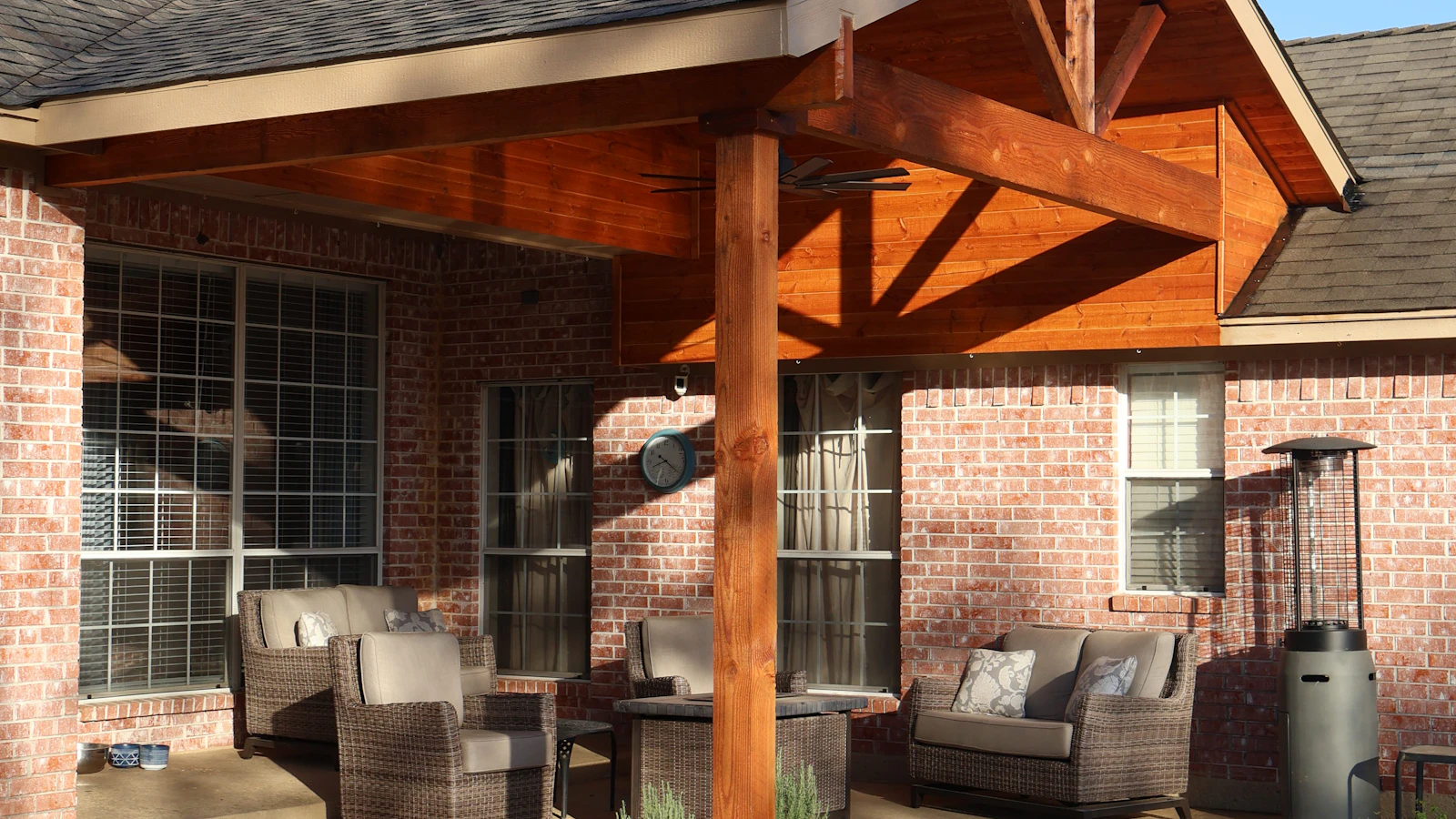
Anywhere the sun is the enemy and the space needs to work like a room. West- and south-facing slabs pull the hardest shade duty in Texas, and a foam-core insulated roof — the kind that can leave the space feeling up to 20° cooler — is the only structure here that genuinely wins that fight. Solid covers also take the rain question off the table, carry ceiling fans and lighting as a matter of course, and hold their own in the neighborhoods where builders left bare concrete behind every new house. If you've read this far and you're already comparing aluminum roof types, alumawood vs insulated panels is your next stop, and the three builds, priced by material, are on the covers page.
Louvers: the truce that costs extra
Adjustable-louver systems are the one structure that refuses to choose — slats open for winter sun and stars, angled for July afternoons, closed tight when a storm rolls in. They're real, we build them, and they sit at the premium end of the pergola world. Households that genuinely need both answers — a view lot with a brutal western exposure, say — are the ones the premium makes sense for. Everyone else usually discovers their yard had a clear winner all along.
Whichever wins, it's still a structure
Both carry wind load, both want poured footings sized to the span, and both go through the same paperwork reality: attached builds typically need a permit, freestanding pergolas often don't, and HOAs have opinions about all of it. We design, submit, and build either one — so the honest move is a single measuring visit that prices both against your actual exposure. The argument usually ends on the slab.
Pergola-or-cover questions
Which is cheaper — a pergola or a patio cover?
Which needs a permit in New Braunfels — a pergola or a patio cover?
Which is better for a west-facing patio in Texas?
Two good answers. One right one for your slab.
Weighed and quoted across New Braunfels, Seguin, Schertz, Cibolo & Canyon Lake.
Call (830) 376-0455